Showing posts with label Anglican Church in North America. Show all posts

Friday, April 16, 2021

New Article on the Anglican Church in North America

I have been indulging in some number crunching on the current state of the Anglican Church in North America, which the Living Church has been kind enough to publish on the Covenant blog. If you are interested you can find the article here.

Friday, February 15, 2019

More Church Statistics

With the Anglican Church in North America poised to enter its second decade it seemed opportune to David Goodhew of Cranmer Hall and myself to look at such data as currently exists and provide an overview of where the denomination may be going. Thanks to the Covenant website, you can read our preliminary findings here.

There is much more to be researched and written regarding the most recent expression of the Anglican tradition and it is our hope that this will be realised in the not too distant future. Certainly there is ample scope for a goodly number of doctoral dissertations.

UPDATE, February 16.

For those who wonder about cross-denominational comparisons, comprehensive data on church growth can be found in the ARDA reports for 2000-2010. Below are listed Christian denominations that gained more than 5,000 adherents in this period (Pentecostal churches in red, Holiness churches in green and Eastern Orthodox churches in purple).

The Latter-day Saints gained just under 2 million (+45.5%), while the Assemblies of God (+14.9%), Seventh-Day Adventists  (+29.5%)and Church of God (Cleveland) (+13.9%) gained between 100,000 and 350,000. 

In the 50,000-100,000 range were the Christian and Missionary Alliance(+29.5%), Evangelical Covenant Church (+49.1%), Evangelical Free Church of America (+25.0%) and Vineyard USA (+42.4%).

In the 25,000-50,000 range were the Evangelical-Presbyterian Church (+61.6%), the Greek Orthodox Archdiocese of America (+11.5%), the International Pentecostal Holiness Church (+19.7%), the Presbyterian Church in America (+8.3%), and (unusually) the Unitarian Universalists (+15.8%).

In the 10,000-25,000 range were the Community of Christ (+24.6%), the Pentecostal Church of God (+22.7%), the Baptist General Conference (+8.9%), the Southern Baptist Convention (+0.1%), the Missionary Church (+28.8%), Christian Churches and Churches of Christ (+1.0%), the Mennonite Brethren (+49.0%), the Serbian Orthodox Church in North America (+23.2%), and the Free Methodist Church of North America (+11.5%).

Two other churches gained more than 5,000, the Orthodox Church in America (+10.1%) and the Church of God of Prophecy (+8.0%).

ACNA's recent gains would appear to track those of the Orthodox Church in America pretty closely, with a projected gain of 6,500 in the course of a decade, or a roughly 6% decennial increase (a rate comparable with the Orthodox Church in America and the Presbyterian Church in America and greater than the Southern Baptist Convention)

Saturday, July 01, 2017

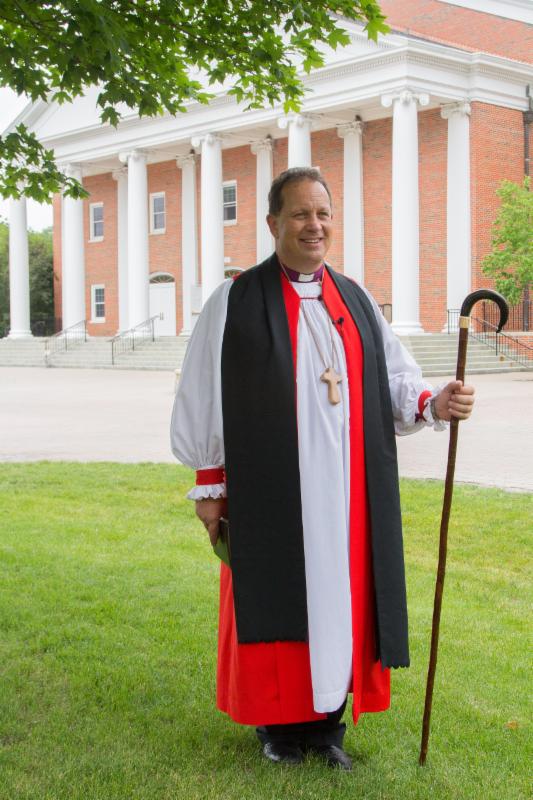
A Missionary Bishop for Europe


Yesterday saw the consecration at Wheaton College in the United States of the Reverend Canon Andy Lines as Missionary Bishop for Europe, following the decision of the Scottish Episcopal Church to amend canon law on marriage to permit same-sex unions. A graduate of Durham (University College, 1982), Lines served in the British Army from 1983 to 1988. He was ordained for the South American Missionary Society in 1997 (at the age of 37), having worked as a missionary to Paraguay since 1991. He has been General Secretary of Crosslinks and chairman of the Anglican Mission in England.

Archbishop Foley Beach of the Anglican Church in North America had this to say:

After the American revolution, the new Anglican Church here - then called the Protestant Episcopal Church - could not get the establishment in England to provide a bishop.  It was the Scots who came to the rescue and consecrated Samuel Seabury in 1784 as the first American Bishop.  It is a privilege to now return the favor to those in Scotland who are crying out for oversight.
 
It will be interesting to see whether such a move will dramatically alter the prevailing dynamic within the Church of England. The statement of support from Bishop Rod Thomas of Maidstone, whose appointment was supposedly intended to reassure conservative Anglicans that the Church of England remained a broad tent, suggests that "border crossing" may be here to stay (and not in Scotland alone).

Wednesday, November 26, 2014

Illinois Supreme Court denies TEC Petition

I have just learned that, with its denial of petition for certiorari, the Illinois Supreme Court has declared Diocese of Quincy vs. The Episcopal Church et al (2013) to be the law in the state of Illinois. A precedent for diocesan disaffiliation now exists in a state previously presumed to favor deference to the hierarchical argument. Interesting times!

Update: November 27

The following are revealing extracts from the Illinois Supreme Court ruling. The reference to the telling "concession" regarding the national church's lack of involvement in diocesan assets in ¶ 50 is revealing about how the courts adjudicate this sort of dispute. While at this remove I am a somewhat hazy as to what I actually said, my point in ¶ 54 was that the legislative history and the language of the Dennis Canon have nothing to say about dioceses. No one arguing the national church position has yet introduced testimony that the implications of the Dennis Canon for diocesan property were discussed at the time of its enactment (Walter Dennis died in 2003 and - apparently - left nothing to indicate what he - as drafter of the canon - intended). Given that most of Dr. Mullin's affidavits have been filled with references to canons mandating dioceses to do something, if dioceses were to be governed by the Dennis Canon surely it would have said so?            

¶ 39 Contrary to the Church’s position, this is not a “documents only” case. In addition to reviewing numerous exhibits, the trial court heard an extensive amount of conflicting testimony and argument from the parties and made factual findings therefrom. Although determining whether to apply a deference or neutral-principles approach may, on its face, appear to be strictly a question of law, the court had to weigh the evidence presented in doing so. As the trier of fact, the trial judge was in a superior position to judge the credibility of the witnesses and determine the weight to be given to their testimony. Buckner v. Causey, 311 Ill. App. 3d 139, 144, 724 N.E.2d 95, 100 (1999). When contradictory testimony that could support conflicting conclusions is given at a bench trial, an appellate court will not disturb the trial court’s factual findings based on that testimony unless a contrary finding is clearly apparent. Buckner, 311 Ill. App. 3d at 144, 724 N.E.2d at 100.

¶ 50 The property in question in this case consists of the funds in the National City account and, although not emphasized by the Church on appeal, a deed to a piece of real property referred to by the Diocese as the “Diocesan House.” The deed has been included in the record on appeal. It is undisputed the Church is not a party to the deed. Instead, the deed reflects title to the property is held by the Trustees. The language of the deed does not provide for an express trust in favor of the Church. The “Discretionary Agency Agreement,” which is the contract between the Trustees and National City, is also contained in the record on appeal. Like the deed, it is undisputed the Church is not a party to that agreement. A review of the agreement does not indicate otherwise. It is also undisputed the Church has never had any involvement with the account, i.e., it never made any deposits or withdrawals, never authorized distributions, and never exercised any type of control over the account at all. In fact, in its brief on appeal before this court, the Church clearly states it “has never asserted that it owns those funds or any of the Diocese’s assets, but rather has consistently asserted that they belong in the hands of the Episcopalians who are the proper leaders of the Diocese.” This is no small concession.

¶ 51 The Church also fails to cite any relevant legal authority to support the removal and substitution of the diocesan corporations’ directors. Instead, it emphasizes the provisions of the Religious Corporation Act (805 ILCS 110/0.01 to 51 (West 2012)), which imposes certain requirements on the incorporating body with regard to trustee membership. See, e.g., 805 ILCS 110/46d (West 2012) (a trustee may be removed from office for, inter alia, abandonment of the denomination). However, it is undisputed the diocesan corporations were not organized under the Religious Corporation Act. Thus, its requirements have no application here.

¶ 52 Moreover, Dr. Mullin, the Church’s own witness, testified he knew of nothing to prevent a diocese from incorporating. Indeed, the Church does not argue the Diocese could not incorporate or was required to do so under the Religious Corporation Act. See 805 ILCS 110/35 (West 2012) (organizations formed for the purpose of religious worship may become incorporated under the Religious Corporation Act). In fact, religious organizations in Illinois may incorporate under either the Religious Corporation Act or the General Not For Profit Corporation Act of 1986 (Not-for-Profit Act) (805 ILCS 105/103.05(a)(8) (West 2012)). While the Not-for-Profit Act provides for the removal of corporate directors, the Church did not attempt any such removal under that act. See 805 ILCS 105/108.35 (West 2012); People ex rel. Muhammad v. Muhammad-Rahmah, 289 Ill. App. 3d 740, 742-43, 682 N.E.2d 336, 338 (1997). (In fairness, it likely lacked any authority or standing with which to do so as it is not a member of either the Trustees or Diocese of Quincy corporations.)

¶ 53 The trial court also found the evidence did not demonstrate the funds were held by National City in trust for the Church. The neutral-principles approach can involve examination of religious documents such as a church constitution for language of a trust in favor of the central church. Jones, 443 U.S. at 604; Maryland & Virginia Eldership of the Churches of God, 396 U.S. at 368 (Brennan, J., concurring, joined by Douglas and Marshall, JJ.). Under a neutral-principles analysis: “the outcome of a church property dispute is not foreordained. At any time before the dispute erupts, the parties can ensure, if they so desire, that the faction loyal to the hierarchical church will retain the church property. They can modify the deeds or the corporate charter to include a right of reversion or trust in favor of the general church. Alternatively, the constitution of the general church can be made to recite an express trust in favor of the denominational church. The burden involved in taking such steps will be minimal. And the civil courts will be bound to give effect to the result indicated by the parties, provided it is embodied in some legally cognizable form.” Jones, 443 U.S. at 606.

¶ 54 An examination of the evidence reveals nothing to demonstrate an express trust, an implied trust, or any other interest vested in the Church. As stated, neither the deed nor the Discretionary Agency Agreement provides for an express trust in favor of the Church. Further, our review of the Diocese’s constitution and canons does not suggest diocesan assets were ever impliedly held in trust for the Church. After Jones, the Church adopted a trust canon (Title I.7.4, referred to by the parties as the Dennis Canon). That canon provides parish property is held in trust for the Diocese and Church and restricts a parish’s ability to dispose of its property. However, it appears undisputed the Church’s canons do not contain similar language with respect to diocesan property being held in favor of the Church. In addition, Bonner testified the Dennis Canon does not apply to property owned by a diocese. Our review of the record reveals nothing to suggest the opposite conclusion. Accordingly, the trial court’s findings in this regard are not against the manifest weight of the evidence.

¶ 55 In sum, the evidence presented demonstrates title to the funds and real property lies with the Diocese. Following our review of the record, we cannot say the trial court’s findings were arbitrary, unreasonable, or not otherwise based on the evidence. Nor can we say the opposite conclusion is clearly apparent in this case. As a result, the court did not err in finding in favor of the Diocese. We commend the trial court for its detailed order, which we found quite helpful in reviewing this matter.

Friday, October 03, 2014

The New Anglicanism

The best most fruitful incoming parishioners in my neck of the woods have been evangelicals coming to Anglicanism (at least Good Shepherd’s brand of it) for the expositional teaching wedded to liturgical worship (a unique niche I think). I’ve found that many coming in from TEC are looking for a church like the one they grew up…ie. TEC sans “the gays”. And they tend to be angry that “their church” was stolen from them (not seeing how that theft was in part due to complacency and docility in the laity). That - back to the past - ethos is not what Good Shepherd is about and so many of them are disappointed when they find that we expect people to serve, to belong to a small group, to open their bibles during sermons etc. I’ve had more internal strife arising from these folks than from any other.

This comment by the rector of one former Episcopal parish in upstate New York speaks to the issue of an emerging Anglican identity that interests me as a scholar. It reflects the increased emphasis on active discipleship that tends to characterize successful congregations in a post-Christian society. It might also be said to bear comparison with the 19th century Anglo Catholic tendency to eschew the identification of the Anglican tradition with anything other than the practices of the Primitive Church.

Reading this (admittedly off-the-cuff) comment, however, I can't help wondering what it means for the next phase of Anglican development. Granted the ultimate division (in practice, if not in theory) of the Anglican Communion into two provincial federations, will that portion that seeks to resist the pressure to conform historic Christian teaching to the secular culture of the Global North ultimately retain anything that was historically considered distinctively Anglican about it? For many of those who ultimately abandoned Anglicanism across four centuries, of course, it was the precisely the desire to reconcile the irreconcilable that was at the root of their unease. Today's self- identified Anglicans appear to have solved that problem, but I wonder if there won't be an accompanying cost.

Friday, July 25, 2014

Quincy Appeal Affirms Lower Court Decision

The Fourth District of the Illinois Appellate Court has just upheld Judge Ortbal's ruling in The Diocese of Quincy vs. The Episcopal Church. In their ruling, the justices commend the lower court for its "detailed order," and express concurrence with the view that the Dennis Canon may impose restrictions on a Parish's ability to dispose of its property but impose no comparable restriction on the freedom of a Diocese. "A review of the evidence presented in this case, including testimony from Dr. Mullin, the Church's own witness, does not clearly demonstrate the existence of a hierarchical relationship between the Diocese and the Church," declares the court. "Indeed, the Church's authority is not readily ascertainable without an impermissible investigation into matters of polity." (Para. 48)

¶ 19 During the three-week trial that followed, 11 witnesses testified. We will recount only what is necessary to resolve the issues raised on appeal.

¶ 20 Dr. Robert Bruce Mullin testified for the Church as an expert regarding its structure and history. Mullin opined the Church was hierarchical. When asked the basis for his opinion, Mullin responded, "Because it is self-evident from evidence itself, you know, that all you have to do is look at the structure of the Episcopal Church and history of the Episcopal Church and it is a hierarchical church. No one is going to question the Episcopal Church is hierarchical before 2008." Mullin then testified in detail regarding the history of the Church.

¶ 21 However, on cross-examination, Mullin agreed his opinion the Church is hierarchical is not expressed in the Church's constitution. He also agreed neither the Church's constitution nor its canons specifically reference a three-tiered form of governance. Mullin further agreed the Church's constitution and canons do not prevent a diocese from withdrawing from the Church. Mullin was unaware of any attempt under Illinois law to remove the members of the Trustees from their offices. While Mullin testified the members of the Diocese forfeited their offices by leaving the Church, he could not point to the "magic moment" when they did so. He also agreed the Church cannot compel a diocese to contribute any money. Instead, the Church suggests what should be contributed. Historically, the lack of support from the dioceses has been a "frequent problem." Mullin also admitted the Church's constitution and canons do not provide for the discipline of a diocese.

¶ 22 Dr. Jeremy Bonner, a specialist in Church history, testified for the Diocese. According to Bonner's testimony, the Church is "an extremely decentralized association" of state churches or dioceses. The Church's constitution lacks a supremacy clause and a mechanism to enforce its canons or legislation against a diocese. According to Bonner, the most striking characteristic of the Church is its lack of any supreme judiciary. During his testimony, the following colloquy took place:

"Q. In your opinion, can a religious organization which lacks a constitutionally established executive and judicial function which has no language of supremacy in its constitution function as an hierarchical church?

A. I do not see how.

Q. How can [the Church] then enforce its canons against a member diocese?

A. It can't. It can express its displeasure and can exert moral outrage and attempt to persuade its dioceses of the need to change, but recent disputes have shown the limitations of that strategy."

¶ 23 Bonner also testified he was unaware of any canon that purports to give the Church authority to assert control over a diocese's property. He explained while the so-called "Dennis Canon" (Title I.7.4) purports to declare a trust in parish property to restrict a parish's ability to dispose of it, that canon does not apply to property owned by a diocese.   

Tuesday, September 10, 2013

Neutral Principles Rule!

There is no provision in TEC's Constitution or Canons which require prior approval of a diocesan constitution or its canons. There is no express prohibition against withdrawal of a diocese. In sum, reviewing the governing documents from a secular perspective, there is no explicit or clearly delineated expression of TEC's claim that the General Convention is the ultimate authority or judicatory of the Church. 

Thursday, May 09, 2013

Observations of the Quincy Trial, April 2013

Now that proceedings are concluded, I wish to share such portions of the transcript as are currently available. Reading what I actually said is a salutary reminder of how new the adversarial process is to me; it's far removed even from a stormy academic debate.

First we have Allan Haley's attempt - on behalf of the Diocese of Quincy (ACNA) - to set the history of TEC in a broad context on April 9:

Then we have Mary Kostel's cross-examination on behalf of TEC on April 10:


Finally we have a most intriguing report by Mike Romkey of my academic counterpart, Dr. Robert Bruce Mullin, on the stand on April 30:

Chatting during recess, Father Stone remarked that Mullin was a formidable witness he would not want to take on in court. As Runyan began his cross-examination of Mullin, it became evident that it would be equally uncomfortable to be in the witness chair with the South Carolina lawyer asking questions.

Runyan wore a black suit with a red power tie. He looked directly at the witness and often smiled as he asked detailed questions that tended to present lots of detailed information before asking Mullin whether he agreed or disagreed, or whether in his estimation a statement was true or false. His questioning tended to work around the edges of issues, gradually accumulating information that would lead to an overall conclusion. He worked to bring the witness along with him, following Mullin's answers by remarking, "All right," or "OK then," before going on with his next question. Runyan started off quizzing Mullin on how much money TEC had paid him for expert testimony. Was accurate, Runyan asked, to say that TEC had paid Mullin nearly $900,000 for testimony going back to 2007. Mullin said it was. Mullin said he has an arrangement to be paid $15,000 per month to even out the payments.

Runyan asked Mullin about his practice of annotating bills to keep track of on what he had spent research time. Runyan then put up a slide showing Mullin's billing for his research into the matter of Episcopal Church hierarchy. The billing was concentrated in two years after Mullin became TEC's expert witness. Runyan asked if the slide showing when Mullin's researched focused on hierarchy was accurate. Mullin told Runyan the slide looked about right.

Had Mullin published any peer-reviewed papers on Episcopal Church hierarchy?

Mullin told Runyan nothing he has written on the subject has been published yet.

Runyan asked if the audience for Mullin's research and writings on church hierarchy had been mainly lawyers and judges?

Mullin said yes, that was case.

Runyan knew Mullin's testimony and affidavit in detail, and in the course of Runyan's questioning, Mullin corrected, amended or qualified several points.

Runyan put up slides quoting constitutions from the Roman Catholic and a protestant church, each containing language explicitly stating those churches' hierarchal natures. He asked Mullin why such language wasn't in the Episcopal constitution.

Mullin said such language wasn't present because it was the accepted sense of things.

Runyan asked Mullin about the word "accession" and what it means.

Mullin said that when individual dioceses acceded to the greater Episcopal Church, they ceded the power to later decide to be independent. The dioceses had the power to act independently while forming a union, but once that association was made, it was permanent.

Runyon asked Mullin what TEC acceding to an international Anglican communion organization implied. It was a different kind of accession, Mullin said, one that did not imply TEC surrendering authority.

Runyan recounted Mullin testimony saying that his survey of 19th century commentary provided "an unequivocal and unanimous view of the hierarchical nature of the church and a lack of independence of its dioceses." With a smile, Runyan said that kind of statement was like waving a red flag in front of a lawyer. He then presented a series of slides from 19th century Episcopal sources that seemed to contradict Mullin.

"Furthermore, each diocese is absolutely independent," one said. Another from 1883 said "certain limited powers" were given to the national church, "leaving the respective dioceses independent as to all matters which concern dioceses only."

Mullin took issue with each statement for a variety of reasons, saying one didn't qualify as commentary, and that others were exaggerations or misrepresentations of what the author intended to say.

Testimony was expected to continue through the week with the possibility things will be prolonged for written and oral arguments over the discovery issues that came up Tuesday. After that, it will be up to Judge Ortbal to sift through evidence and write a decision. It does not appear it will be an easy case to call. The two sides are diametrically opposed in their positions, and each time the one side introduces an opinion represented to be factual, true and probative, the other side introduces evidence to contradict it or throw it into doubt.

As Judge Ortbal said at one point with certain resignation while ruling on an objection, "This trial has been nothing but opinions."

Read the whole thing at Virtueonline.

Monday, April 29, 2013

A Thought to Ponder

I’m not your average pew sitter—which is what makes up the vast majority of those in congregations: people who have a few unfirm opinions, aren’t all that active, certainly aren’t pushing their beliefs one way or the other, and are fairly non-committal and passive.  Most people haven’t thought a whole lot about a lot of things, haven’t troubled to inform themselves, and don’t particularly care.

In short—the way “most human beings” are about most things. That’s not a “bad” thing either—it’s just the way human beings are.

Once, however, you’ve studied, experienced, thought, formed groups, and generally made some very firm decisions—and acted upon them consistently over the years and decades—you’re in a new and very different category—that of the activist.

Those people—and again, I include me in that group—are very very solidified in their beliefs.  Their lifestyles, values, actions, thoughts, emotions, beliefs, world views, are all aligned and in congruence.  They’re not “fly by night” and you’re not going to read them a verse in Scripture or quote something from Augustine that will make them slap their foreheads and say “goodness, I never thought of that!”  Further, since they don’t share the same most basic of definitions of key theological concepts, you’re not even actually “communicating” when you *do* share a verse in Scripture or a passage from Augustine.  We really are not even playing the same game, much less on the same playing field.

Once someone has reached that point about certain issues, and even more about fundamental and foundational world views, it will take far far far more than rhetoric to change one’s mind or heart.  It will take something akin to a large bundle of dynamite—in short, an “act of conversion.” 

Over the years I've frequently disagreed with Sarah Hey (for it is she), but her comment appended to a post orginally authored by her on Stand Firm does wonderfully illustrate the notion of liberal Protestantism's "different Gospel," which conservative Anglicans have been endeavoring to critique since the 1990s (if not before). My first thought, however, is whether the average pew-sitter in ACNA is any more of an activist than his or her counterpart in TEC, and if not, why not?       

Saturday, April 20, 2013

Anglicanism Future: Church of the Incarnation, Pittsburgh

Last week, I was on the stand in Quincy, Illinois, testifying to the condition of Anglicanism past; on April 13, I listened enthralled to Bishop FitzSimons Allison (a sprightly eighty-nine year old retired bishop of South Carolina) on the Scylla and Charybdis of Anglicanism present; and on April 14, I observed the state of Anglicanism future, as manifested at Pittsburgh’s Church of the Incarnation. While my focus here is on Church of the Incarnation, Bishop Allison’s remarks threw Sunday’s worship experience into sharp relief.


In 2011, when Trinity Cathedral withdrew from its earlier commitment to dual membership in both the TEC and ACNA dioceses, a significant section of the congregation felt unable to remain. Initially meeting as a house church, Incarnation’s founders – foremost among them, Fathers Paul Johnston and H. Lawrence “Laurie” Thompson and their wives Sharon and Mary – worked to assemble the necessary mission structures even as they searched for a suitable building for Sunday worship. Initially, the mission explored possible sites in the Johnstons’ neighborhood of Squirrel Hill and Pittsburgh’s downtown community (known as the Golden Triangle), but without success. Instead, there came an entirely unexpected offer from the owners of Bar Marco, an upscale wine bar located in a former firehouse in Pittsburgh’s Strip District. The upper level of the firehouse, then used for art exhibitions, would be available on Sundays after 3:00 PM (when Bar Marco closes for the day). To Incarnation’s leaders, it seemed an answer to a prayer.


To see this former firehouse for the first time dramatically alters one’s perspective on the nature of liturgical space. As with most missions, the weekly need to set out congregational seating and vest a table (purchased from IKEA) to serve as an altar helps emphasize the priority of the Body of Christ over the church building as sacred space set apart from the world (while there may be a spiritual downside to this, it is the nature of this community). The room itself is long and rectangular approached by two rear staircases one rising from the bar and the other from the rear kitchen. Above the congregation looms an impressive cast tin roof installed in a less utilitarian age when form mattered as much as function (even for the emergency services). At the west end (the liturgist may deplore it, but Church of the Incarnation celebrates the Eucharist at the West End) are three large glass windows looking out onto the Strip. In a reminder that worldly and sacred space intersect at Incarnation, the art on exhibition remains in place (except for one painting temporarily taken down to accommodate the Cross), but Incarnation also proudly celebrates its own individually crafted Paschal Candle (the work of Suzanne Trenney).


Incarnation is a church of artists and musicians, actors and dance professionals, and even an architect who is presently working on developing movable screens to make best use of the temporary space. Many of Father Johnston's students (he teaches music at Carnegie Mellon University) have blessed Incarnation with their professional skills (last Sunday’s worship, for example, featured a euphonium quartet) and the congregation boasts a portable keyboard – acquired by Father Johnston – with a musical character much closer to an organ than one might expect. It is also privileged to have two seminary professors – Laurie Thompson and John Macdonald of Trinity School for Ministry in Ambridge – and a professor emerita of English literature at Geneva College – Ann Paton – providing pastoral support. Such personnel advantages are, however, no substitute for congregational participation and in that Incarnation is well supplied, from the choral team to the altar guild and hospitality ministry. Other ministry teams are already being planned, since the possibility of burnout increases exponentially with a congregation that has no institutional footprint.


For a congregation whose average Sunday attendance has been steadily rising in the past year (more than sixty were in attendance on Sunday) the setting presents a truly different perspective on evangelism. If it is not Anglo-Catholic, neither is it the archetypical Evangelical mission. Tradition, in its broadest sense, and the confluence of spirituality and the arts both matter. The world is literally just a staircase away. The communicant approaching the altar is greeted not by stained glass windows that shield the Body of Christ from the World, but clear glass opening onto the somewhat grubby reality of an urban commercial district. That reality is also the mission field and those receiving the Sacrament also receive an emphatic reminder of the end to which the Eucharist is intended.

  
No mission – like no human being – will ever get everything right, but it’s hard to fault Incarnation on the essentials. Much remains to be done, not least the manner in which the congregation will actively relate to its secular neighbors, but to be present is to see twenty-first century Anglicanism in action. If you live in Pittsburgh, pay them a visit. I can guarantee you won’t be disappointed.

Friday, November 09, 2012

The Church of the Incarnation, Pittsburgh

Well our friends at Pittsburgh's Church of the Incarnation are up and running, having been been received at the 2012 diocesan convention as a Mission Fellowship-in-Formation. They even have a nice new website. If you're looking for something a little different from standard ACNA fare, this may be one to check out.

May they continue to prosper!

Thursday, January 05, 2012

Barchester Redivivus: A Tale of A Cathedral, A Resolution and Human Frailty

Author's Note: This report is written primarily to assist members of Trinity Cathedral in working through our recent crisis. The author will entertain comments here, but gives fair warning that purely pejorative observations regarding members of Trinity - or the leadership of ACNA or TEC - will be unceremoniously deleted. While he has no control over comments at sites that may link to this post, he requests that commentators at other sites observe the same courtesy. A related thread of interest may be found here.

January 7 Update
: See Lionel Deimel's response.

Introduction

On Thursday December 15, the Chapter of Pittsburgh’s Trinity Cathedral adopted a motion to reaffirm the charter of incorporation adopted in 1928 when Trinity assumed pro-cathedral status. In an announcement issued the following day, the Provost – Canon Catherine Brall – declared that the vote "effectively ends the governance provisions of the Special Resolution which was adopted by Chapter in August, 2008 and ratified by the parish in September, 2008." Just three years ago, the adoption of the Special Resolution drew considerable attention both within and beyond the Diocese of Pittsburgh.

Providing some context for how it was adopted, implemented and ultimately revoked seems timely. The author of this report – a member of Chapter when the Special Resolution was first adopted – has consulted with Archbishop Robert Duncan, Bishop Kenneth Price, Canon Brall, all the current members of Chapter (though not all have chosen to respond) and former Chapter member John Campbell, who served until November 2011 and resigned from the Cathedral following repeal of the Special Resolution. A good faith effort has been made to incorporate the competing narratives surrounding recent events, yet it is an underlying premise of the report that the Special Resolution had an inherent merit and that the manner of its demise fell short of the standards to which Trinity had previously been committed.

Trinity and Realignment

To understand the context of the Special Resolution, it is necessary to go back to the original decision of the Diocese of Pittsburgh to realign in 2007 and 2008. Unlike the Dioceses of San Joaquin, Fort Worth and Quincy – where most of those who chose to remain with The Episcopal Church (TEC) are generally happy with the course pursued by the national church – the process of diocesan realignment in Pittsburgh separated a significant number of clerical conservatives (and their congregations) from the soon-to-be Anglican Church in North America (ACNA). It was in this context that, two months before the second – and final – vote on realignment, the Chapter of Trinity Cathedral debated and adopted the Special Resolution (the text of which, interestingly enough, can still be found on the cathedral website), which was subsequently ratified by the wider parish membership. Canon Brall has stated to me recently that she understands that the word "ratified" was deliberately employed so as to signify approval without any legal change in the character of the by-laws and charter of Trinity Cathedral. To my recollection this was not a fact emphasized to members of the Chapter at the time when the concept of the resolution was put forward by the Provost, formally developed by two members of the Chapter (one a lawyer and future ACNA member; the other the TEC-leaning head of the World Affairs Council) and carefully reflected upon by the whole body, of which the present author was then a member.

Put simply, the Special Resolution affirmed both the parish’s "unique historical roots" as "the first church of Anglican and Episcopal worship in Pittsburgh," and a commitment made in September 2003, when the present crisis in TEC began to take shape, "to preserve the unity of The Episcopal Church and to facilitate resolution of divisions within the body of the Church," as grounds for refusing at that time to make an "exclusive choice" between the two church bodies (TEC and the future ACNA). To that end the following commitment was made:

The people and Chapter of Trinity Cathedral commit themselves to being a Christian community, in which the love of God is manifest to all; in which the grace of our Lord Jesus Christ may be evidenced in our practices of self-restraint, mutual accountability, and extending respect and forbearance to those with whom we differ; and in which the fellowship of the Holy Spirit may be exemplified in our choosing to forgive rather than retaliate, to heal hurts rather than nurse grudges, and to remain together when it would be easier and less costly to go our separate ways. (Emphasis added.)

To this was added a commitment to remain a "unified Cathedral," even to the extent of being the seat of two Bishops from contending jurisdictions. To that end, provision was made for both jurisdictions to elect representatives to the Chapter and for both Bishops (if two existed) to serve as co-presidents. At the same time, the Special Resolution expressed an expectation that it would be permitted representation in the diocesan conventions of both competing bodies. Perhaps most importantly, the Special Resolution contained the following provision:

BE IT FURTHER RESOLVED, that – if circumstances necessitate the application of the principles and provisions of this Special Resolution – the By-Laws governing the parish and Chapter of Trinity Cathedral shall be amended to incorporate these same principles and provisions, and that subsequent amendment of those By-Laws to alter substantively these principles and provisions shall require concurrence by a two-thirds majority of Chapter members elected by Trinity parish and by a two-thirds majority of those parish members present at a special meeting of the parish congregation, duly convened according to the By-Laws.

It should be noted that, in the Canon Provost’s understanding, since alterations to the by-laws would have required the consent of the diocesan standing committee at a time when the Diocese of Pittsburgh was headed for division and reorganization into two separate entities, said alteration was impossible. She further notes that she did receive a communication from the TEC Standing Committee stating that they could not acknowledge the Special Resolution. This was not communicated to the Chapter, at least not in the form of a declaration of legal non-recognition.

The Reception of the Special Resolution

It should not be imagined that the Special Resolution was particularly well received at the time or subsequently, although Canon Brall did receive some expressions of appreciation from persons within and beyond the Diocese of Pittsburgh. Many observers viewed it as an abrogation of responsibility and the reflection of an inability to make hard choices. The fact that Trinity had for more than a decade been limping along financially only added to the conviction that the cathedral was seeking to have its cake and eat it. It cannot be denied that the short-term practical consequences were welcome. Nevertheless, few people in 2008 could have predicted with certainty how the two Dioceses would relate in the long-term.

Many had hoped that the relatively even balance of Episcopal and Anglican populations and the presence in the TEC Diocese of a significant body of theologically conservative clergy would promote a spirit of forbearance. The property disputes (for which ACNA must accept a measure of responsibility in choosing to pursue them) and the fact that it seems increasingly clear that conservatives in the TEC Diocese lack the numbers needed to shape such a course have changed all of this.

To reduce the perceived failure of the Special Resolution to this level, however, is in part to abrogate the cathedral’s responsibility for clarifying what the Special Resolution was about. "This Resolution shall be publicized to all lay persons and clergy within the existing Diocese of Pittsburgh and to appropriate authorities within The Episcopal Church and the Anglican Communion," read the final clause "with a prayer that – by the grace of God – these principles will serve as a Christian model for reconciliation within divided communities." The Special Resolution was never, as many members of Chapter understood it, about drawing people to Trinity (though obviously any drawn to the congregation by the principles enunciated would have been welcome), and it was never publicly understood as promoting congregational growth, though Canon Brall states that she certainly hoped for such an outcome. To assert that the failure to grow is somehow due to the confusion provoked by the Special Resolution is, in the view of certain Chapter members at least, disingenuous; that failure is entirely separate from the purpose of the Special Resolution and long pre-dated realignment. Where the disjunction arose, at least in the view of the Resolution’s proponents, was in the parish’s failure to communicate to the wider world the principles that were so clearly enunciated in 2008. It should be acknowledged, however, that at the time it did receive coverage in the parish newsletter, the parish and diocesan (undivided) website and in press releases.

The tragedy of recent events, however, has been not that Trinity Cathedral has made the decision to align solely with the TEC Diocese of Pittsburgh, but the manner in which that decision was reached, which demonstrated neither "mutual accountability" nor "respect and forbearance." By their action, those who voted to support the December 15 motion inflicted a devastating – and quite unnecessary – blow to the community whom they – quite sincerely – believe themselves to be supporting.

2011: The Year of Decision

During the first half of 2011, members of the Chapter devoted themselves to Kevin Ford’s Transforming Church: Bringing Out the Good to Get to the Great, a book recommended by Canon Brall, as part of ongoing discussions concerning Trinity Cathedral’s long-term strategic plan. Several of those involved found it pertinent to the cathedral’s situation and the discussions around it productive. No indication was given at that time that there was any need to revise the mode of governance under the Special Resolution.

In February, however, TEC Presiding Bishop Katherine Jefferts Schori proposed to attend the TEC clergy renewal of vows on April 19 (the Tuesday of Holy Week). Canon Brall states that she received representations not to host the Presiding Bishop in any capacity, but there is also discontinuity of perception in how the calendar clash with the already scheduled ACNA renewal of vows was handled. Canon Brall states that she only inquired of the ACNA diocese whether they could change their schedule, while the ACNA perspective is that an attempt was made to persuade Archbishop Duncan to relocate the ACNA service. The cathedral ultimately hosted a public forum for the Presiding Bishop on the Tuesday evening after the TEC renewal of vows in Wilkinsburg.

If the ACNA claim is accurate, given the importance accorded by the Special Resolution to serving both dioceses equally, it was at least unfortunate that the question of moving a pre-scheduled ACNA event was even raised. It should also be noted, however, that the Canon Provost made inquiries of ACNA about hosting this year's ACNA diaconal ordinations – which did not occur the previous year owing to an untypical morning wedding – but did not learn of the ACNA diocese’s rejection until she read the public announcement that they would take place at Church of the Ascension.

At the April Chapter meeting, the Canon Provost solicited feedback from members as to the qualities desired in the new TEC Bishop to be elected in 2012, which included "a reconciler," "one who accepts the Special Resolution," and "Biblical and Prayer Book perspective rather than civil law." According to the Canon Provost, the latter two suggestions came from self-identified Anglicans. At the May Chapter meeting, interim TEC Bishop Price, while declaring that he and Archbishop Duncan were working well together, noted that some in the Episcopal Diocese were wondering how a new Bishop might react to the Special Resolution. When later asked why Calvary Church had been chosen for the consecration, he responded that although logistical considerations were a factor there was also a belief in some quarters that it should take place "in a facility solely dedicated to the Episcopal Church." Apparently this elicited both "comment and concern" among some of those present. Bishop Price, it should be noted, informs me that the Chapter minutes exaggerate the importance of the latter concern and that "the relative size of the two buildings was the driving force."

At the June Chapter meeting, according to Chapter minutes, "the issue of the Cathedral’s status with both dioceses was raised." According to Mary Thompson, this came in the form of a statement from Canon Brall at the end of the meeting: "I think the Special Resolution no longer serves the best interests of the Cathedral," rapidly followed by adjournment of the meeting. The Chapter minutes summarize the Special Resolution as intended to "(1) bring people together and engender kindness between ACNA and TEC and (2) draw people to the Cathedral who didn’t want to choose between the two." Reference to the original resolution will of course demonstrate that the second was never an overt object, while the first utterly fails to convey the theological underpinning behind the Special Resolution. With such misunderstanding (at best) even on the representative body of the cathedral, it is perhaps no wonder that people were so easily persuaded to dispense with the Resolution. The assertion was also made that both dioceses were increasingly making the choice not to use the cathedral for diocesan-wide events. It was ultimately agreed that both dioceses need to be approached to find out whether, or indeed if, they viewed the cathedral as integral to their future.

At the August Chapter meeting, reports from discussions with both bishops suggested that neither viewed the status quo as defined by the Special Resolution to be viable. Archbishop Duncan has stated that his view has always been that the Special Resolution functioned well with regard to Chapter and the relationship between the two dioceses, but not as regards the congregation. From this conclusion developed his proposal for what he termed "Phase Two" of the Special Resolution: an evening congregation serving the ACNA members of the parish that would complement a morning service that might either be specifically for TEC or continue the present arrangement. Bishop Price notes that in his meeting he simply restated the fact that the Special Resolution had not helped Trinity to grow. Members of Chapter requested clarification of the statement from the TEC Diocese that the cathedral did not fit in with its mission, but also recommended that both sides be asked to clarify their view of the cathedral’s legal status and that more effective ways be defined to serve both dioceses. Consideration also began of a white paper – prepared by the Canon Provost – discussing future options for Trinity.

According to the Canon Brall’s recollection, the structural deficiencies of the first draft of the white paper in large measure reflected the fact that no one on the executive committee had followed through on its commitment to produce a white paper, forcing her to write one at short notice. While a September 15 report of the executive committee listed exclusive affiliation with ACNA as an option, the first draft of the white paper – presented at the October Chapter meeting – did not. Instead, it worried the existing good relationship with Bishop Price might not carry over to his successor if the Special Resolution endured. It argued that the Resolution had failed to be an agent of reconciliation, that working with both dioceses consumed precious time and energy, and held out the possibility of the TEC diocesan offices relocating to Trinity to provide needed rental income.

In passing, it should be noted that the white paper contained a seemingly unnecessary swipe at the "Anglicans" for moving away from the "Downtown community and the homeless" to the North Shore, despite the fact that the principal congregation of and for the homeless in the neighborhood – with whom the cathedral has worked – is an ACNA one. However, Michael Caligiuri has asked me to convey that he believes this to have arisen from a remark he made earlier that an evening ACNA service designed to attract young adults might have difficulty relating to the homeless population that Trinity continues to serve, a remark that he would also have made of a TEC service catering to a similar demographic.

The essential conservatism of the TEC Diocese was a constant refrain of the white paper, together with the dubious assurance that Trinity would remain "open and welcoming," that a Sunday ACNA evening service was an option – even without the Resolution – and that ACNA clergy could still marry their parishioners at Trinity. It is noteworthy that the Canon Provost made it clear at the November meeting of Chapter that the white paper was for Chapter review only and would not be shared with the wider congregation, an indication, perhaps, that it was not envisaged that the latter would not be involved in the decision to end the Special Resolution. (She is today not sure whether or not she envisaged that a white paper would ultimately be distributed to the congregation).

Discussion and significant amendment of the white paper continued through the fall, but with clear indications that the Chapter remained internally divided. Only at the October and November meetings was the white paper fully discussed by the whole Chapter. Following the December meeting of the executive committee, it was the impression of many members of Chapter, including two members of the executive committee, that debate on the white paper had been postponed indefinitely, that the cathedral would continue to operate under the Special Resolution for the foreseeable future, and that December’s Chapter meeting would concern itself solely with the cathedral’s Strategic Plan. In private, however, several people were pushing for a motion similar to that ultimately presented on December 15.

Walt Adkins – whose comprehensive notes on the subject have been gratefully received – offers perhaps the most useful perspective on the anti-Special Resolution position. As one who has responsibility for buildings and grounds Mr. Adkins has perhaps a more acute sense of structural atrophy than most people. In his view, it was the failure of the two Dioceses to leave their disagreements at the doors of Trinity and focus on a joint program of worship, music and service that celebrated the best of ACNA and TEC that was to blame for the failure of the Special Resolution, not a lack of communication on the part of the "small remnant" that constituted the Trinity congregation. His own observation of certain comments by ACNA members of Chapter (most notably the phrase, "sleeping with the enemy") only confirmed him in the belief that, after months of fruitless debate, "the November Chapter meeting had brought the Special Resolution to its end" and that "any serious participant of the November meeting had heard me declare the [Special Resolution] dead." Postponing its demise would simply have compounded the error.

The Chapter Meeting of December 15

Regular business was conducted in a noticeably perfunctory matter. The final item of business – entitled "white paper/strategic plan" – was announced and Canon Brall reported the executive committee’s recommendation that Chapter focus on strengthening Trinity’s role as a cathedral and address the white paper at a later date.

Even before any discussion on this recommendation could be entertained, Trinity representative Andrew Thiros requested that, since he believed that any discussion must center around the corporate charter, he be allowed to propose a motion reaffirming Trinity’s charter, which was seconded by appointed by TEC clergy representative Scott Quinn. Officially the TEC position was that the property section of the Special Resolution was not considered by TEC to be in effect. At no point did Mr. Thiros discuss the implications for the Special Resolution; that had to be articulated by others. It is the opinion of Walt Adkins that Mr. Thiros has made observations to this effect – though not in the form of a motion – on at least two previous occasions. Bishop Price concurs, noting that while he did not know the form of the motion that was presented in advance, he anticipated that something of the sort would occur after the November meeting. Despite objections from the secretary, Bette Salmon, that the motion was not on the agenda and should therefore only be discussed and voted upon at the next meeting, Canon Brall allowed it to be presented. Under questioning, Mr. Thiros maintained that adherence to the Charter superseded the Special Resolution and stated that his decision to present the motion had been made two days previously and after discussion with certain members of Chapter.

Despite the fact that the executive committee had met just 30 minutes earlier, no hint had been conveyed to at least two of its members, including the secretary. Moreover, no response was forthcoming either from Canon Brall or the chair of the executive committee (the senior warden), Dorothy Amis, as to why other members of the executive committee were kept in the dark. The Canon Provost has stated that she knew that a motion might be put forward but had no specific knowledge of the form – "I don’t know," she says, "who was involved in talking about this." A noteworthy aspect of this selective knowledge is the experience of Chapter member Bill Kaiser, who was told by the husband (not a member of Chapter) of the chair of the executive committee some days prior to the meeting that he hoped Mr. Kaiser would vote in favor of TEC, without specifying what he meant.

Not only was there no prior notice of the motion, but no copies of the motion (or of the Special Resolution and the relevant sections of the charter) were distributed at any stage of the proceedings. Executive committee member Wicks Stephens, like Mr. Thiros an attorney, who also received no advance warning of the motion, warned that the intent of the motion was to end the Special Resolution and he considered the manner of its introduction to be underhanded. Following discussion, Mr. Stephens made a motion to table the reaffirmation of the charter, which failed. According to Michael Caligiuri, however, this motion was to table until April, "an impossibly long time frame to have this motion hanging over us" (on this point, the author doesn't necessarily disagree).

So bad had the atmosphere become that ACNA clergy representative John Cruikshank (who has close family ties to Trinity) then introduced a motion of no confidence in the Canon Provost, which was conducted with the latter still in the chair. The Canon Provost states that she appealed to Bishop Price as to how to proceed, and he responded that she should simply entertain a voice vote. While the motion was subsequently reported to have failed, some of those present are of the opinion that it sounded equal. By the same token, no one requested that a written ballot be taken, which any Chapter member was certainly free to do.

Debate lasted from approximately 5:50 PM until 7:25 PM, and from 6:00 PM onwards the burden of the debate appears to have been borne by the supporters of Special Resolution, including Mary Thompson, a member of the cathedral congregation, whose husband Laurie has been assisting clergy at Trinity. Both are ACNA supporters who agreed to work with the Special Resolution somewhat against their better judgment at first and, in so doing, discovered something of value. They were and are especially disturbed to see the theological principles underpinning the Special Resolution being sacrificed to expediency. Furthermore, in the opinion of Sharon Johnston at least, "questions of legality, procedure or appropriate professionalism were not sufficiently addressed," with the mood of the majority being more along the lines of "let’s put this to bed."

Two members of Chapter – Ed Murry and Michael Caligiuri – did raise the practical necessity of TEC affiliation to Trinity’s identity, while a third, Walt Adkins, expressed concern about the "divisive language" being used by opponents of the motion, but for the most part, at least as far as certain observers were concerned, supporters of the motion sat in silence. Mr. Caligiuri has subsequently communicated to me his own rationale for the, in his words, painful decision to vote in the affirmative which I quote as follows:

Jesus calls us to serve people, not dioceses, and I believe that the Special Resolution was making it progressively more difficult to do that . . . I knew this was an unsustainable situation when Archbishop Duncan told the Executive Committee that he was asking Anglicans ready to leave the cathedral to stay. When someone needs to be asked to stay, there's definitely a problem. If, as time progresses, it's clear to me that being a cathedral interferes with our ability to serve the people, I'll vote then to stop being a cathedral. I believe our calling to serve the least of our brothers is far greater than to serve Bishops and Archbishops.


Finally, and only after she had asked how leaders willing to act in such a fashion could be trusted in the future, Bette Salmon finally called the question, recognizing that debate could not continue indefinitely. The motion to reaffirm the charter of Trinity Cathedral was put and passed by 11 votes to 7 (Canon Brall notes that it actually should have been recorded as 12-7, since Bishop Price voted in favor and has the right to exercise a vote under the charter). No reason was given at the time for why the vote should not be two-thirds (in accordance with the Special Resolution) rather than a simple majority, although as reported above the TEC position is that Special Resolution carried no binding legal authority. Unusually, since there are frequent absences by non-congregational representatives on both sides, all the TEC members of the Chapter were present while three from ACNA – Archbishop Duncan, Donald Bushyager and William Lytle – were not. In a final irony, the listed agenda item was never discussed.

Bishop Price insists that he had had no advance notice of the vote (and the Canon Provost confirmed that she had not alerted either Bishop to what was planned, in itself a remarkable admission) and noted that he delayed offering an opinion in the hope that Archbishop Duncan – who was delayed – would ultimately make it to the meeting. Several observers maintain, however, that in the course of his remarks he shifted from conciliatory language about the need for the dioceses to work together to one of stating that the Special Resolution had been "accepted but not approved" by the TEC diocesan standing committee, that he was the "only ecclesiastical authority" present and that it was his responsibility to "enforce" the charter. According to one witness, he also declared the Special Resolution to be "illegal." For the last three years, of course, he and his Diocese have been complicit in the illegality, by accepting a half-assessment and electing representatives in accordance with the Special Resolution, although Bishop Price argues that such actions were courtesies, in the latter case observed by Diocesan Convention at his request, and not an act of complicity.

Conclusion

While the long-term implications of the December 15 Chapter meeting remain to be seen, it is plain from this account that the Canon Provost’s letter of December 16 is an inadequate summary of what occurred. While the decision may not have been made "lightly" it was certainly made "hastily," and may well have been of dubious legality (the fact that the secretary had no advance notice is a matter of note). Furthermore, the Chapter had indeed achieved a "consensus," namely to put off a decision on the final status of the cathedral in favor of working on the congregation’s strategic goals.

In a recent communication, John Campbell writes as follows:

When I was newly elected to the Cathedral Chapter, Canon Brall sat me down in her office and we reviewed a document she had prepared outlining her expectations for Chapter members. One of the items that she felt was essential to Chapter participation was the ability to reach a consensus. She remarked that the contentious years prior to her tenure were marked by battles between factions resulting in winners and losers, and that she sought to end that behavior through a process of consensus building around the issues at hand. Throughout my time on Chapter, this model was successful. I cannot remember any Chapter vote in which there was more than one or two negative votes or abstentions. Indeed, the process of the composition and approval of the Special Resolution was in itself an ideal model of consensus building.

As Mr. Campbell remarks later, "the Special Resolution was working about as well as it could be expected to." It would never be perfect nor could we expect either or both dioceses always to work with it as we wished; rather it might grow and change and the option to repeal was always there if that was the overwhelming desire of those involved. Furthermore, there was a clear impression – verbally, if not in writing – given in 2008 that this was not for the Chapter alone but for the congregation to decide. The failure to keep that intent uppermost is alarming.

In the final analysis, certain members of Trinity’s leadership decided to return to the political methods that were in vogue before Canon Brall took charge of the cathedral, pushing through a decision by stealth which could easily have been obtained simply by following the provisions of the Special Resolution in securing its termination. As it is, the congregation has now been deprived of the right to decide for itself with which body to affiliate – or indeed whether to continue with the Special Resolution – a right accorded every other congregation in 2008. More importantly, the Chapter has now set a precedent for how business will be conducted in the future. There has been remarkably little effort made since the vote by those who voted for the measure to provide pastoral care for those whom they must have known would be hurt by the decision. Indeed there seems to be a total inability to understand what was wrong not with the choice but with the process by which the choice was made.

The tragedy here is not that the Anglican Church in America lost a cathedral, but that the cathedral family lost its very raison d’être.

Saturday, December 17, 2011

No Summary Judgment for TEC in Quincy!


I suspect that there's not a little irritation currently being voiced at 815 and Goodwin Proctor, and I'm afraid I can't help but find that thought somewhat gratifying.

Update: The Anglican Curmudgeon naturally has some thoughts on the matter.

Update 2: My dear wife last night reminded me of the dangers of hubris and, on reflection, I stand suitably rebuked. My continued hope - which I know is also that of the ACNA legal team in Quincy - is that this ruling will be the precursor to a negotiated settlement that allows both sides to pursue their mission honorably and effectively, one that does not include the sort of stipulations prescribing membership in ACNA that are currently bedeviling the situation here in Pittsburgh. Further litigation will do no one any good.

Sunday, November 06, 2011

Discerning the Promised Land: Anglican Diocese of Pittsburgh Convention, November 5, 2011

“We are not in it to be right, to justify ourselves, or to look down on others.” With such words did Bishop Neil Lebhar of the Gulf Atlantic Diocese conclude his final teaching of Pittsburgh’s diocesan convention meeting on the grounds of St. Vincent’s College (a Benedictine foundation) in Latrobe, Pennsylvania. The warm welcome offered by St. Vincent’s Benedictine prior and the Roman Catholic Bishop of Greensburg, was only reinforced by tales of parishes that had surrendered their buildings only to receive encouragement and aid from sympathetic congregations of other denominations.

For Lebhar – whose Florida congregation was among the first to leave its church building – a willingness to surrender material security for reliance on God to provide should be part of the character of ACNA and he must have welcomed such testimony as that provided by members of All Saints, Rosedale, now happily worshiping in a local Methodist church. Or Paul Cooper of New Life in Mars, whose congregation meets in the local Catholic Church and whose 83-year old churchwarden has a list of eight congregations to be planted before he dies! Or Doug Sherman of St. James in Penn Hills, who reported that all but one congregant had joined the exodus, that the parish was doing much better financially and that “it’s awesome to have [the decision to leave] behind you.” All that was needed to underscore such accounts was the announcement by Chancellor Robert Devlin that this was the first convention that he had attended when the Anglican Diocese was not in litigation. As of the Pennsylvania supreme court decision, parishes whose deeds were in the name of the Board of Trustees no longer owned their property and that decision would not be appealed.

Much of the business of the day, however, was devoted not to existing congregations but to those in embryo, including two new parishes (St. Michael’s, Nashotah, WI, and Trinity, Yuba City, CA); eight mission fellowships (six in Illinois and one each in Iowa and Minnesota); and ten mission fellowships-in-formation (two in Pittsburgh, four in California and five in Illinois). Amid the inevitable presentation of Steelers towels to the out-of-town visitors, mission representatives spoke to the importance of the link with Pittsburgh, however fleeting it might ultimately be. From Sanctuary, Lawrenceville, came words of praise for the Archbishop’s flexibility in the models of mission that he is permitting. The priest at Holy Spirit, Folsom, CA (the town not the prison, as he hastened to add), described a congregation that began in a restaurant and moved to a funeral home chapel. His fears about the cost were allayed when, unprompted, the proprietor observed that “when you get to 100 people we may have to start charging for wear and tear.” Among the most inspiring, the reports from the Chicago greenhouse movement, among them two missions serving Spanish-speaking populations; Church of All Nations, deliberately planted in a low income neighborhood; and Heritage, whose mission is to multiply congregations in nursing homes!

Canon Missioner Mary Hays, in welcoming the new congregations, spoke to her personal experience of serious injury, which had obliged her to slow down and had led her to “hear” better what people were trying to tell her about spiritual and physical burnout. She spoke of a class she had taught at Trinity School for Ministry where even African clergymen had confessed to being “too busy” to pray. Space needs to be created in which God can act, in individual lives and in congregations. Jenni Bartling – celebrating her tenth anniversary as Congregational Developer for New Churches (more like a paid hobby than a job) noted how far the Diocese had come since Archbishop Duncan pledged in 2000 to plant ten congregations in the next decade. Today there was increasing emphasis on local mission; renewal of displaced congregations who, though not new, were now doing something new; and an increasing number of experienced church planters coming forward (as opposed to those embracing church planting because it was “cool.” Other snippets of news about the condition of the Diocese trickled out as the day wore on.

1. Our now customary ballot for diocesan offices with only enough candidates to fill the slots (which led the Archbishop to plead that “the purpose is not Soviet-style voting,” and to encourage anyone wishing to propose names from the floor).

2. The adoption of a resolution to base parish representation on Average Sunday Attendance rather than Communicant Numbers, since ACNA does not collect data on communicant membership.

3. A report that our financial situation has greatly improved since last year, with a small surplus. Particularly noteworthy is the fact that of the $920,000 to be raised from the Godly Share (the voluntary tithe that is now the standard for parish giving), $50,000 comes from parishes outside the territorial diocese.

4. The Anglican Relief and Development Fund has provided $4.9 million for 106 projects around the world.

5. A speaker from Christ Church, Plano, spoke on behalf of Anglican 1000, which, he stressed, is not the church-planting arm of ACNA – only bishops, clergy and lay leaders have the authority to do that. In the time between summer and fall of 2011, the number of church plants known to Anglican 1000 jumped from 130 to 180 (including ten from Cuba). Few dioceses though have the church-planting resources available in Pittsburgh and they should be utilized to the full. When Archbishop Duncan pledged in 2009 to plant 1,000 churches in five years, there was astonishment yet the present auguries are propitious as a new foundation for “biblical, missionary Anglicanism” is laid.

The teachings by Bishop Lebhar and his wife Marcia represented one of the high points of the convention. Conflict in churches, he told the assembly, is “a major problem for American Christians. We go shopping for non-conflict churches – good luck!” We are generally viewed as failures if we’re involved in conflict, and yet sometimes conflict is a necessary part of our spiritual growth. Often the problem is not so much with the information that we gather on a problem but how we interpret it, and it is in the white heat of interpretation that conflict flourishes. In a conflict situation, the default position for those who are afraid is to cling to the familiar rather than to trust in God’s power to preserve us from even the worst of situations. God’s purpose in difficult times is both to humble and to test. Often our preference is to relieve pressures rather than have the inner workings of our hearts revealed. Members of his Diocese were all obliged to go through a process of coming to terms with their lack of control and of learning to forgive their detractors.

Marcia Lebhar later took up the theme of trust with a reflection on the reality of the paucity of water in Canaan as compared with the Israelites’ experience in Egypt. The heart of idolatry is the insistence on a “Plan B” and God has prepared a new Anglican for ACNA that its members must expect on God’s terms. Finally, and at the close of proceedings Bishop Lebhar, introduced the imagery of the challenge posed to Judaism posed by the Romanized culture of Herod the Great’s Caesarea and the warning to the infant Christian Church given by the Epistle of Jude, namely of cultural surrender. “Many Americans,” said, “have become co-dependent on the culture.” His greatest fear for ACNA is that today’s vitality will weaken and acculturation make its way in, for if we acquiesce to the prevailing culture we cannot save those now imprisoned by it.

One curious postscript, a letter from former Bishop Alden Hathaway expressing his love and continuing prayers for Pittsburgh and seeking letter dimissory to the Diocese of South Carolina. Curious because the request was to the ACNA Bishop of Pittsburgh but in respect of the TEC Diocese of South Carolina, albeit in many ways a Diocese of one. Make of it what you will.

I’ve given up predicting when I will finally leave Pittsburgh, as perhaps my devoted readers have now realized. As long as I’m here I will keep the record, for whatever it may be worth.

I've noticed that dear David Wilson and Tara Jernigan have stolen a march on me this year, but I think I make up for it in quantity if not quality.