Showing posts with label Church of England. Show all posts

Saturday, July 01, 2017

A Missionary Bishop for Europe


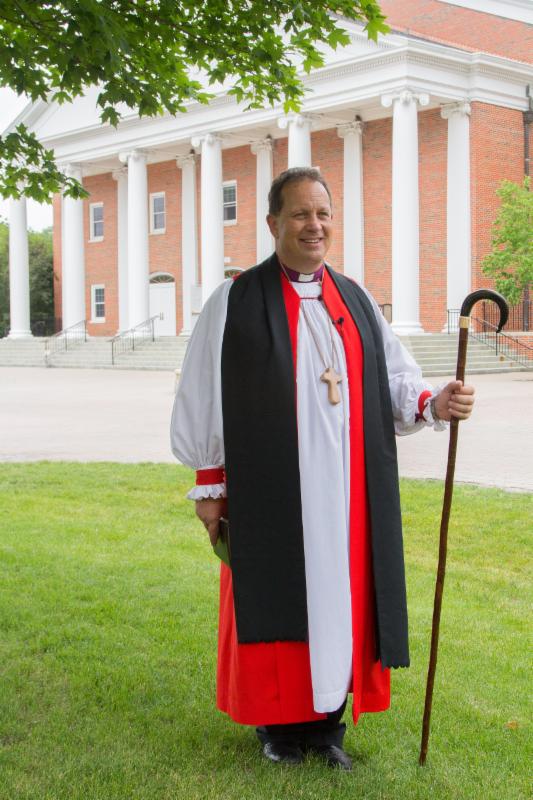
Yesterday saw the consecration at Wheaton College in the United States of the Reverend Canon Andy Lines as Missionary Bishop for Europe, following the decision of the Scottish Episcopal Church to amend canon law on marriage to permit same-sex unions. A graduate of Durham (University College, 1982), Lines served in the British Army from 1983 to 1988. He was ordained for the South American Missionary Society in 1997 (at the age of 37), having worked as a missionary to Paraguay since 1991. He has been General Secretary of Crosslinks and chairman of the Anglican Mission in England.

Archbishop Foley Beach of the Anglican Church in North America had this to say:

After the American revolution, the new Anglican Church here - then called the Protestant Episcopal Church - could not get the establishment in England to provide a bishop.  It was the Scots who came to the rescue and consecrated Samuel Seabury in 1784 as the first American Bishop.  It is a privilege to now return the favor to those in Scotland who are crying out for oversight.
 
It will be interesting to see whether such a move will dramatically alter the prevailing dynamic within the Church of England. The statement of support from Bishop Rod Thomas of Maidstone, whose appointment was supposedly intended to reassure conservative Anglicans that the Church of England remained a broad tent, suggests that "border crossing" may be here to stay (and not in Scotland alone).

Tuesday, November 08, 2016

The Promise and the Limits of Anglican Growth

Growth and Decline in the Anglican Communion, 1980 to the Present
A Day Conference

Friday 24 February 2017: 10.30 to 5 pm
Whitelands College, part of the University of Roehampton, London
(train: Barnes; tube: Putney Bridge – District Line)

A major new study of growth and decline across the global Anglican Communion is coming out, published by Routledge. It provides in depth academic research by an international team from leading universities, giving both overall coverage and detailed case studies from five continents.

The conference is an opportunity to hear about and discuss the book’s findings. Speakers include:

Professor David Voas, University College, London
Dr Emma Wildwood, University of Cambridge
Dr Barbara Bompani, University of Edinburgh
Rev Dr David Goodhew, Cranmer Hall, St Johns College, Durham University
The Rt. Revd. Dr. Graham Kings, Mission Theologian in the Anglican Communion

To find out more and book on the conference, go to:

A discounted fee is available to full time post- or under-graduate students. 

The day conference is part of the 175th anniversary celebrations of Whitelands College.

Wednesday, October 21, 2015

Light not Salt: Michael Nazir-Ali at Durham


The inaugural lecture of the Hensley Henson Lecture on The Church in Politics: Past, Present and Future took place on October 19 in Durham Cathedral and was addressed by Bishop Michael Nazir-Ali, retired diocesan of Rochester, whose interventions on marriage and the family, Christian-Muslim dialogue, homosexuality and multiculturalism have made him as controversial a figure as was Henson in his own day.

Bishop Michael opened with an account of how - while organizing meetings for Christians to raise issues of concern with parliamentary candidates during the 2010 election - he was informed by several clergy of his acquaintance that this was not an activity that they felt called by God to undertake. Such "pietistic fideism" however, Bishop Michael insisted, is simply not an option for Christians, nor can it be right simply to accept separation of the private and "sacred" from the  public and "secular." Coupled as these notions are with a post-Enlightment celebration of the individual - in the West at least - they run counter to the concept of covenant that underpins a Christian understanding of the moral (if not the civil and ceremonial) law, and it is from the moral law alone that it is possible to discern the common good.

The enduring significance of Matthew 22, vv.15-22, with its implicit separation of secular from sacred, must not be understood as a blanket injunction to deference to civil authority. The Reformation, even as it promoted a degree of distance between church and state, in no sense purported to silence the latter in the public arena. Moreover, there is a clear separation between, as Bishop Michael put it, between the "godly magistrate" of Romans 13 and the "beast" of Revelation 13.  The state necessarily forfeits its authority when forbidding what God commands, or, more concretely, commanding what God forbids (Henson, it might be noted, was an admirer of the Confessing Church under National Socialism).

The default position of the Church of England, Bishop Michael argued, has been to conform to the divine injunction to be "salt of the earth," a pastoral presence "working invisibly" through society. Yet this injunction is coupled with another urging Christians to be "lights of the world." If in the Middle East - and perhaps Africa and Asia also - there is a need for an emphasis on the dignity of the individual as against communal and social mores, in the West it is the bonds of family and community that stand most in need of renewal. Such renewal depends upon a commitment to be a light in the darkness that not only draws others to itself but also casts a light - not always welcome - upon policies, customs and behaviours that detract from the health of the community. Such a critique will - if correctly pursued - be holistic in character, free from political partisanship and conscious of the inevitable shortcomings of all human solutions to social disfunction. As Bishop Michael noted, invoking Richard Niebuhr, Christ is ultimately "above culture," since no temporal culture can exhaust the riches of the Gospel.

Thursday, June 05, 2014

Hensley Henson on the Consequences of War

As part of my duties as Ramsey Fellow, I am assisting Durham Cathedral in their preparations to observe the centenary of the First World War. Prominent among the primary sources available to us are the diaries of that renowned ecclesiastic Hensley Henson, who in 1914 was Dean of Durham Cathedral. The entries for the war years are by turns, amusing, sobering and touching. What follows (with the kind permission of the Dean and Chapter) is a portion of the entry for August 27, 1914:

What effect has war on Religion? I suspect that the effect is almost universally bad. There is no time for thinking, a vast stimulus is given to feeling. While the intellect is barren the emotions run riot. In an atmosphere of morbid sensationalism every superstition grows rankly. Death and the fear of death lie like a pall on the intelligence and paralyse the conscience. Every form of teaching and devotion which seems to illumine or affect the shadowed existence beyond the grave appeals to the bereaved, and a fat soil is prepared in which charlatanry can flourish. The prophecy-fanaticks secure a hearing & every type of wonder worker can count on a market. Besides, there is wide-spread and serious confusion of morals. War itself is hard to place in the scheme of Christian morality & patriotism is a creed which covers many sophistries. The sacred apologists of War with the New Testament as their text-book cannot be said to be an impressive company. Their embarrassment extends itself from the pulpits to the pews & everybody worships with a troubled conscience. Moreover, the daily reports of fighting & every form of violent atrocity are nowise wholesome feeling for the human spirit, which they inflame and distort.

Henson, it should be noted, was no pacifist. He willingly spoke at recruiting drives throughout County Durham and frequently preached to soldiers of the Durham Light Infantry, but it is evident that he had little time for the clerical jingoism of the early months of the War. He presciently foresaw the implications of the carnage of the Somme and Passchendaele on public opinion twenty years later, when he stood out as one of the few Church of England bishops actively opposed to Appeasement.         

Tuesday, August 06, 2013

Crumbling Edifice: The Church Commissioners and the Decline of the Anglican Establishment

Review: Andrew Chandler, The Church of England in the Twentieth Century: The Church Commissioners and the Politics of Reform, 1948-1998 (Woodbridge, Suffolk: The Boydell Press, 2006).

On January 15, 1991, First Church Estates Commissioner Douglas Lovelock brought disturbing news to the bishops of the Church of England. After more than a decade of property speculation that had significantly increased the value of the investments of the Church Commissioners, the economic bubble had finally burst and the Church of England faced a need for drastic economic retrenchment. Almost overnight, a cacophony of protest erupted as Anglicans in the pews (and episcopal palaces) denounced the hubris of the Church Commissioners in so believing in their financial expertise as to squander long-term security for short-term gain.

Andrew Chandler's weighty tome on the fortunes the Church Commissioners represents a most valuable contribution to scholarship, with still relevant insights concerning the way in which ecclesiastical assets can and should be managed. Much of the value of The Church of England in the Twentieth Century derives from its reliance on the internal papers of the Church Commissioners, providing a window into the mindset of the relatively small group of men (and occasionally women) who set postwar fiscal policies that allowed the Church of England to establish adequate pay scales for its clergy and maintain church buildings that would otherwise have fallen into disrepair. Their correspondence throws an equally revealing light on the activities of Anglicans in the pews in the years following the Second World War. 

Formed in 1948 from the merger of the Ecclesiastical Commissioners (a corporation established by Parliament in 1836 to manage church estates and revenues) and Queen Anne's Bounty (a charity organized in 1704 to provide grants to poor benefices and loans for the repair of clergy houses), the Church Commissioners were one of the fruits of the twentieth century managerial revolution, and enjoyed the active support of Geoffrey Fisher, perhaps the last archbishop of Canterbury to take much interest in the institutional church. Chandler demonstrates the increasing detachment of future archbishops from the work of the Commissioners, typified in the lament of Archbishop Michael Ramsey to the then bishop of London in 1967. "One of the more godly laymen on the Board of Church Commissioners," he wrote, "has asked why the meetings do not begin with prayer. When I became Chairman I was informed that it was not their custom to have prayer and I followed the existing pattern. I must confess that at the time I sometimes used to feel the proceedings were so ungodly that the custom was just as well, but there is really no reason why this should be the only ecclesiastical body which does not pray at its meetings." (Michael Ramsey to Robert Stopford, 19 May, 1967, quoted on 150-151).

Ramsey's comments reflect the unease with which many churchmen contemplated (and still contemplate) the world of finance. The general lack of clerical experience in that arena (the present archbishop of Canterbury notwithstanding) coupled with the perception that markets were not renowned for respecting the dignity of the individual only accentuated the gulf between the guardians of the Church's purse and the shepherds of its souls. That said, the history of the Church Commissioners is in great measure a history of the postwar Church of England. Despite the relative autonomy granted by the Church of England Assembly (Powers) Act of 1919, the half century that followed attested to the enduring supremacy of Parliament (characterized most notably by the parliamentary rejection of a proposed revision of the Book of Common Prayer in 1928). The Church of England remained a national church, its clergy vested with responsibility for all within their pastoral cure, not merely those who identified as practising Anglicans, and its assets were intended to benefit the nation.

The early Commissioners, insists Chandler, bore the stamp of the era in which they were formed, "a pragmatic liberal bureaucracy; a brisk but humane enterprise set in motion by experienced and committed executors who understood their tasks sensibly, rationally, without the show of politics." (24) They were typified by Malcolm Trustram Eve, Third Estates Commissioner from 1952 to 1954 and First Estates Commissioner from 1954 to 1969. A seasoned industrialist (with interests in cement), Eve sustained and developed the policies adopted by the Church Commissioners in the late 1940s, that included an embrace of Stock Market transactions at the expense of the Church's earlier reliance on the purchase of government bonds, investment in commercial property and the reorganization and consolidation of the scattered agricultural holdings of the Church of England.

Such policies brought about a sea change in the relationship between the Church and those who continued to be its tenants, whether London householders or rural farmers. Particularly after the lifting of rent controls in London in the early 1950s, the Commissioners began to emphasize the income potential of their properties in the London districts of Maida Vale and Hyde Park (although they conceded the importance of affordable housing for their tenants in Paddington). Similar concerns reshaped relations with their farmer tenants, particularly after the suppression of the glebe as a mechanism binding the income from a specific piece of land to a particular incumbency. Agricultural land that failed to provide an assured source of revenue was now as likely to be sold as retained.

The transformations of the 1950s, though striking, were as nothing compared to the revolution of the era that followed. The success of investment in London commercial property during the 1960s and 1970s, encouraged the Commissioners to pursue more risky schemes a decade later. The lifting of exchange controls led to extensive investment in foreign property, both in the United States (especially California and Texas) and Japan, and by the early 1980s property accounted for two-thirds of their portfolio. The Commissioners also embarked upon a series of what Chandler terms economic "dreadnoughts," most notably shopping centres such as St. Enoch's in Glasgow and the Metrocentre in Gateshead. Sizable commercial loans (often without fixed interest rates) were secured from the high street banks, including a staggering £250 million line of credit from National Westminster Bank. With the hindsight of the past decade, the inevitability of a crash seems inescapable.

There was, however, another side to the story, one for which Archbishop Ramsey's earlier comment is revealing. Both the Church Assembly and its successor the General Synod responded to the Commissioners' early successes with requests for ever increasing levels of expenditure on clerical stipends, pensions and investment in bricks and mortar. The results of this collaboration between the Commissioners, the Church Assembly/General Synod, and the Dioceses were frequently beneficial but they were also costly. Few of the beneficiaries, whether parishes, clergy or bishops, seemed conscious that with increased costs come increased liabilities. The long drive to raise clerical stipends that culminated in the establishment of Central Stipends Authority in 1973 was accompanied by an unseemly degree of inter-diocesan strife over funding priorities. When the widening gap between assets and obligations toward clerical pensions became evident during the 1970s, the unwillingness of the General Synod to embrace a measure of fiscal restraint arguably set the Commissioners on the road to the speculative plunge of the 1980s. Dioceses and parishes were always quick to identify uses for new income but slow to propose sacrifices that might keep the budget in balance.

Chandler's narrative is replete with illuminating insights into the mind of the postwar Church that range from the debates surrounding the closing and consolidation of rural parishes to the bitter struggle over divestment from South Africa. Bishops, dioceses and cathedrals all receive attention, as do the financial ramifications of such intra-church matters as Faith in the City and the ordination of women. For an institutional history, the number of vignettes of local situations (the evoling of the debate over the sale of redundant churches first to Roman Catholics in 1950s and subsequently to Muslims and Sikhs in the 1970s and 1980s is particularly fascinating) is extensive. One will search in vain, however, for references to Honest to God or the "Durham Affair," there is little discussion of church-state relations prior to the cataclysm of 1991, and the wider Anglican Communion is conspicuous by its absence. Perhaps the most misleading feature of the book is its title, which might lead the casual reviewer to assume a comprehensiveness which is absent, but as a revelation of the workings of the institutional church, Chandler has provided something of enduring value. Anthony Trollope's Archdeacon Grantley would have understood the mindset of the Church Commissioners all too well, which perhaps adds poignancy to Chandler's ultimate conclusion:

The historian of the last fifty years is left only to wonder what the next fifty years will bring. Unless the societal patterns which have gathered such force in the later twentieth century are superseded by new ones which combine to benefit the cause of corporate Christianity, at some point decline must bite through the sinews of the body and into the structures, the very bones, which give it solid form and movement. Arguably it was the achievement of the Church Commissioners between 1948 and 1998 to maintain, by a steady, ongoing reform of particulars, the contours of an order and a method which might well have decayed and even collapsed in some areas without their efforts. Perhaps a future age will observe that their legacy was simply to hold back for a period of time a decline which was altogether too formidable to be halted by the Churches. (481-482)

Saturday, June 08, 2013

Gerald Bonner: A Life Well Lived

Gerald wrote in his will: I desire that I be buried according to the rites of the Book of Common Prayer of 1662 . . . with a celebration of the Holy Communion and without any eulogy or encomium though I ask for the prayers of my friends. His family wanted to do as he wished, but funerals are also for the living, and we want to celebrate all Gerald was and did, so we have put together this necessarily incomplete tribute.

********************************* 

He made you feel honored when he spoke to you, even when you felt you weren’t really deserving of such honour. The verdict of the last clergyman to minister to his spiritual needs embodies the life of Gerald Bonner, a life that transported him from the pre-World War II London borough of Haringey to a distinguished visiting professorship at the Catholic University of America in Washington DC.

The child of an ex-Indian Army officer and a London County Council primary schoolteacher, Gerald was called upon to take up responsibilities at an early age following the premature death of his father. His dedication to repaying the sacrifices of the mother who raised him and to caring for his younger brother Nigel stayed with him throughout his life and he held in high regard the person of Father Damien, the Roman Catholic priest who gave his life for the lepers of Molokai.

A scholarship boy at the Stationers School, he joined the Army in 1944 and saw postwar service with the King’s Dragoon Guards in Palestine. In 2011, when the uprising against Colonel Gadaffi was in its formative stages, he recalled how the troopship carrying him home had docked at a “one-camel hamlet” called Misuratah. After demobilization, he went up to Oxford for three years of study at Wadham College (1949-1952), which he often remarked would have been impossible without the university grant for ex-servicemen.

From Oxford, he entered into service at the British Museum, where he would serve as a keeper of manuscripts for over a decade. During these years he demonstrated a zeal for independent scholarship that led to the publication of his seminal study of St. Augustine of Hippo in 1963. He was also an enthusiastic participant in the work of the Fellowship of St. Alban and St. Sergius, building connections with prominent Anglican and Orthodox churchmen. He spoke regularly at the Fellowship’s annual conference, and was an irrepressible teller of anecdotes at the Entertainment on the final evening.

In the mid-1960s, at the instigation of Professor Hugh Turner, Gerald was invited to Durham to join the Theology Department, where he served as the resident historian among a group of theologians. For many years he carried the burden of teaching church history from the patristic era to the present day. He started courses on Augustine of Hippo, and also on St. Cuthbert and St. Bede, as he felt it wrong that, at that time, nobody in the Theology or History Departments was working academically on the two northern saints whose mortal remains lay in the Cathedral.

Gerald organised a conference on Bede in 1973, attended by around ninety scholars from many countries, and later edited the proceedings under the title Famulus Christi. Bede was also the subject of Gerald’s 1966 Jarrow Lecture, and of his Cathedral Lecture in 1970; more recently, he suggested, at the request of Canon Jones, the text to be put above Bede’s tomb. The guides tell us that this text is an inspiration to visitors and pilgrims at the Cathedral, some even making return visits to pay their devotion. In 1986, David Rollason, Clare Stancliffe and Gerald collaborated in organizing a conference on Cuthbert, and although Gerald felt that his own contribution to this was small, David has written very appreciatively of the help he gave.

Retiring early in order to guarantee that a successor would be appointed, he was granted a new lease of academic life with his selection as Distinguished Visiting Professor of Early Christian Studies at the Catholic University of America (1990-1994). Here he found a community that valued his gifts and students who represented an academic crème de la crème. CUA knew his calibre and set an appropriate value on it. Five years later, Villanova University (a Catholic institution near Philadelphia, where he had delivered an Augustinian lecture in 1970) offered him a semester’s teaching that proved equally rewarding.

He taught several summer schools at Nashotah House Seminary in Wisconsin, following in the footsteps of Michael Ramsey; and was an invited lecturer at academic institutions from Vancouver to Rome, with many places in between. His reputation as an international authority on Augustine was further demonstrated by requests to contribute so many articles to the mammoth Augustinus Lexikon, though he remarked that he was unlikely to be around when the article on Zosimus was needed!

Gerald’s book on Augustine has since been reprinted in paperback; and some of his many articles on Augustine, Bede, Cuthbert, and early church controversies, have been published as collected volumes. A further volume was planned, but his deteriorating health prevented this. He was very touched to be honoured with a Festschrift edited by Augustinian friends in Rome.

As well as his writing, Gerald was always generous with help and encouragement to students, colleagues and friends. A young Austrian scholar who was attempting to catalogue all the Augustinian manuscripts in English libraries found the task taking longer than expected. Gerald responded by spending several days in Salisbury Cathedral library that summer, and several at Holkham Hall in the depths of a very cold winter, to help out in the cataloguing. He welcomed all comers, and was only too glad to share information and insights; he was ‘given to hospitality,’ whether in welcoming new members of staff, entertaining visiting colleagues, or simply bringing old and new friends together for the pleasure of their company. Some will remember him enthusiastically stoking the bonfire and letting off fireworks at our annual bonfire party, whose participants ranged in age from ten weeks to their early nineties.

Gerald eschewed the combative enthusiasm of many Anglican conservatives, but he never allowed that to impede his deeply held convictions. He was deeply committed to upholding the sanctity of life, speaking and writing to that effect in the public arena. In 1994, after the narrow vote by the General Synod in favor of the ordination of women, he long agonised about his decision not to take up his seat in General Synod in order to accept an American professorship. Convinced of the unwisdom of a decision which might impede the reunification of Catholic Christendom, he had trouble accepting that his presence would not have changed the outcome.

He remained a devoted Anglican, being a regular worshipper both at the Cathedral and here at his parish church, where he was a Server at the early morning communion services until infirmity made this impossible. He was always ready to help in any way he could, and one year, when the then vicar was particularly overstretched, Gerald took the weekly service at the Low Newton Remand Centre, doing everything himself, taking the service, giving an address and playing the piano for the hymns.

Gerald was a man of deep learning and powerful convictions, who made it a point never to neglect contact with those he knew. He kept up a regular correspondence with family and friends and his letters were by turns entertaining and profound. In many ways a pessimist (a preoccupation with Augustine’s theology could hardly have made him anything else) and with a private side that even those closest to him could not touch, he nevertheless loved his wife, his children and grandchildren, and the many friends he made over a lifetime that saw his world change out of all recognition. If his loss is grievous to us all for a little while, those whose lives he touched have but to follow the example that he set for them.

He used to say that the Dies Irae, with its emphasis on sin and judgement, was the only suitable hymn for a funeral: but he touched many lives for good, and we pray that his sins may be forgiven and his love and kindness remembered. May he rest in peace, and may light perpetual shine upon him.

********************************* 

We would like to say how grateful we are to all the staff at Melbury Court, where Gerald spent the last five months of his life. They cared for him so well, and with such kindness and consideration, and gave such support to us as well. He couldn’t have been better looked after, and we are so grateful for all they did.

********************************* 

There have been so many loving tributes to him in the letters that we have received that we wish there was space to give them all: 

Gerald was always a gallant gentleman among academics, a link with a world that has passed I think, a world of high principle, courageous views, and scholarship untainted by the modern grab-every-opportunity-you-can. 

It is [Gerald’s] capacity for forgiveness and reconciliation that is above all etched on my mind whenever I think of him . . . [He] was a great-hearted man; just to think of him puts me in fuller touch with the sense of the love of God that is the foundation of life itself. 

I had many conversations with Gerald over the years, mostly on the road to and from St. Cuthbert’s, and invariably found him engaging company . . . I shall remember him as he was, with his good-humoured and ironic acceptance of the odd ways of the world. 

He was always such a good raconteur. We shall remember him as a lively and knowledgeable teacher who brought fun to the lecture room. 

Gerald was a great man and a great scholar. For me, he was a humbling inspiration to whom I owe more than I can say. 

Even though I was never a great fan of Augustine of Hippo, I received from Gerald warmth and encouragement for which I am ever grateful. I will look back fondly on his contribution to my life, a contribution that extended well beyond any immediate academic involvement. He was a wonderful scholar and a true mentor. 

[Gerald] was always so kind and encouraging to me in my academic work; and a good friend who will be much missed. 

Gerald was an enormously faithful friend over the years since Oxford days. There must be many, many people whom his friendship and goodness have touched. 

His life goes on through his immense scholarly achievement and the inspiration and care he gave to his students and postgraduates. I remember with special gratitude and affection his genial kindness to a very half-baked young librarian, when I first came to Durham, and his ready help with any enquiry. 

[He] took an interest in and had a kind word for “new hands” . . . What impresses me is not only Gerald’s own learning but also his humility and humanity – the work of a truly great scholar, to which his many publications bear eloquent testimony. 

One of my earliest memories, as a very small child, was Gerald giving me a model Rolls Royce, powered by batteries - an inspired gift that few would have made for a little girl in the 1950s. I went on to make model ships, build Bayco houses, and eventually drive a tank! I still have the atlas Gerald gave me on my twelfth birthday and although many countries have changed their names and boundaries, it is a much loved book and I use it frequently. 


He was a lovely man and will be dearly missed.
Thursday, May 23, 2013

In Memoriam: Gerald Bonner, 18 June 1926-22 May 2013

Thou Hast Made Us For Thyself And Our Heart Is Restless Until We Rest In Thee
(St. Augustine of Hippo, The Confessions, Book 1)

Yesterday, in his eighty-seventh year, my father Gerald Bonner passed to his heavenly reward surrounded by his loving family and in the City of Durham that had been his home for so many years. Funeral arrangements are pending.

Husband, Father, Friend and Scholar, he has touched the lives of many, both in Europe and North America.

His earthly journey has ended but his reception among the Redeemed (while observing all the Anglican proprieties) will be a joyful one.

Requiescat In Pace    

I Have Fought The Good Fight, I Have Finished The Race, I Have Kept The Faith
(St. Paul, Second Epistle to Timothy, 4:7)

Wednesday, February 13, 2013

From Glittering Images to Absolute Truths: Susan Howatch's Starbridge Sextet

Lent seems the perfect time to reflect upon the ecclesiastical novel.

Church-centred fiction frequently has difficulty resolving the Christian dilemma of being "in the world and yet not of it." If an ecclesiastical novel confines itself to the life of the Church, it risks alienating the reader unfamiliar with—or even antipathetic to—matters considered "churchy." If, on the other hand, it engages excessively with the Church in the world, it risks creating a narrative in which all consideration of the transcendent is sacrificed and the ecclesiastical environment becomes merely a setting for characters shorn of heavenly aspiration. Fortunately, there are novelists capable of transcending such conflicts and Susan Howatch is certainly among their number.

Howatch's Starbridge Sextet was published over a period of seven years, the last—and arguably the finest—Absolute Truths, appearing in 1994. Like Anthony Trollope, her setting is a Cathedral community in southern England (Howatch wrote in the shadow of Salisbury Cathedral). As with Trollope, the conflict between the Bishop and the Dean of the Cathedral forms the central dynamic of the final three novels, but unlike Trollope, the reader is never presented with a cast in which hero and villain are easily identifiable (there are no Obadiah Slopes or Francis Arabins). Indeed, Howatch's twin preoccupations are human fallibility and the necessity of a life transformed by divine grace. Furthermore, although these are novels that focus upon the lives of men engaged in the business of the Church, they are set in the context of a turbulent Great Britain passing from the horrors of economic depression and global conflict of the late 1930s to the cultural unravelling of the late 1960s, when crisis theology or the "new morality" still had meaning beyond the portals of the seminary. In an age when the observations of most bishops of the Church of England evoke little interest even among church-going Anglicans (never mind the wider public), it is well to be reminded of an age when the pronouncements of a George Bell or a John Robinson had the capacity to excite public interest.

Another ingenious feature of the sextet is that while it follows a chronological progression, it also reflects a re-telling of a common story from different angles, most notably those of the three principal characters, Charles Ashworth (Cambridge don and later Bishop of Starbridge), narrator of Glittering Images (1987) and Absolute Truths (1994); Jon Darrow (a member of an Anglican religious order released from his vows to function as a laicized spiritual director), narrator of Glamorous Powers (1988); and Neville Aysgarth (Archdeacon of Starbridge and later Dean of Starbridge Cathedral), narrator of Ultimate Prizes (1989). Outside perspectives are also provided by Aysgath's erstwhile lover Venetia Flaxton, narrator of Scandalous Risks (1990) and Darrow's son Nicholas, narrator of Mystical Paths (1992), though neither novel has, in my opinion, quite the power of the other four.

Howatch's three principal characters—while unquestionably individuals—also serve as theological "types." At one extreme we find Jon Darrow, representative of the Anglo Catholic party at its zenith but also of a mystical tradition that is, as the character acknowledges at one point, beyond parties. At the other pole is the liberal Protestant modernist, Neville Aysgarth, whose disdain for the trappings of ritualism is never far from the surface. Between the two, we find Charles Ashworth, a Prayer Book high churchman increasingly dedicated to resisting the tides of modernity sweeping through the Church of England. Such single sentence summaries do less than justice to the complexity of the characters involved, however, for Howatch displays an enviable skill in exploring both their strengths and their weaknesses. Such a narrative, rendered all the more effective by the fact that it is generally the character that testifies against himself, articulates with resounding force the messages of Sin and Redemption, Incarnation and Atonement, Good Friday and Easter that amplify the limitations of the human condition.

Subsequent posts will explore the principal features of each novel in detail and will be linked to this introduction. It might seem strange to propose such literature for Lenten reading, yet I would personally recommend Absolute Truths (although it is the final part of the sextet, and the penultimate chronologically, it is not necessary to have read the others to appreciate it) as an example of the depths from which a Christian can recover and a reminder that "failure" is as much a part of the human condition for the clerical order as for that of the laity.

Tuesday, August 28, 2012

Newman, Manning and the Anglican Dilemma

From Owen Chadwick's magisterial The Victorian Church Vol. 1 (1966), 300.

Manning and Newman were contrasting types and leaders of Anglicans attracted towards Rome. Newman was a divine, Manning a churchman. Newman looked for theological truth and found it in that church which, he came to believe, represented with least unfaithfulness the doctrine and ethos of the first Christian centuries. Manning knew that the church possessed the truth, but the English establishment allowed the state to adulterate the possession. Newman left the Church of England because it spoke to his conscience with stammering lips. Manning left the Church of England because it let a non-Christian state within its borders and surrendered its guardianship of truth to state officers. Newman left the Anglicans because they were Protestants, Manning because they were established.    

Sunday, July 08, 2012

A Day in York

As one born in the north of England, I blush to admit that I have never visited the see city of the northern Province of the Church of England. Since it so happens that General Synod was meeting here this weekend and two of my collaborators - Kevin Ward and Mark Chapman - on a forthcoming study of the Kikuyu Conference of 1913 (in its day an affair whose ecclesiogical implications looked set to be as far reaching as the election of Gene Robinson in 2003) were to be in town, Jennifer and I decided to meet up with them.


Here's a view from the city walls - champion sight, as any good Yorkshireman would exclaim.


Approaching Yorkminster Cathedral. A nice day (no rain) meant that hordes of tourists were about.


The west doors of the Cathedral. We arrived too late for morning service but returned for choral evensong, which celebrated the 800th anniversary of the awarding of a city charter by King John (three years later that unfortunate monarch had more pressing concerns at Runnymede, so perhaps it was as well that the burghers of York got to him when they did).


Well there's a surprise; a soon-to-be ex-Archbishop of Canterbury and one of his possible successors.

 
In the shadow of Archbishop Sentamu's cathedra, St Michael Le Belfrey upholds the banner of Evangelicalism. 


On a lighter note, this band made a joyful noise as we took a stroll through the town in the early afternoon.

Photographs: Jennifer Bonner (who wisely persuaded me - against my better judgment - that it was time we acquired a digital camera).


Wednesday, May 30, 2012

Coming Home? Or Not.

Greetings on a cloudy Wednesday from the City of Sheffield, where we are now in our second week of residence. Until today the weather has been gorgeous (a little too hot for me, but Jennifer was loving it). The city has some curious similarities with Pittsburgh - a now departed steel industry that has given way to various high tech enterprises (of which Jennifer's employer is one), a gritty working-class culture, friendly and helpful inhabitants - but it is obviously not identical. For one thing, there is a tram system that - unlike Pittsburgh's T - actually serves most of the city neighborhoods. If all goes well, come Friday we will have a rented house in Norfolk Park, about fifteen minutes from the railway station and the tram and about twenty-five minutes from Jennifer's workplace. 

On Pentecost we worshiped at the Cathedral of St. Peter and St. Paul, a handsome pro-cathedral with an excellent choir and a sizable staff. I met on Monday with a worthy Canon to discuss where I might be of most use (since Bishop Steven had suggested we worship there until we had a residence) and got the distinct impression he was a little worried lest my ACNA fundamentalism disturb the present modus vivendi! Interestingly, as far as he was concerned, ACNA was no longer part of the Anglican Communion, but beyond pointing out why they consider themselves so to be, I didn't belabor the point. He did observe that most churches in Sheffield - whether Evangelical, Catholic or Liberal - had a fairly clear identity, except for the Cathedral itself, which strove to uphold a more generic via media. I suspect that we may go and at least try out St. Matthew's, Carver Street, which is currently under one of the flying bishops. It will be a change to get some genuinely catholic liturgy again.

Doubtless there will be more posted here once we get settled. It's very strange to be back in the UK after twenty years, as strange for me as it is for Jennifer. There must be more of the Ishmaelite in me than I imagined.

Monday, March 26, 2012

The Anglican Covenant and the Church of England


Modern Church has kindly provided a comprehensive listing of how the diocesan synods voted on the Anglican Covenant. Dioceses in red opposed the Covenant, Dioceses in blue supported it, and Dioceses in yellow were divided.


Some preliminary conclusions on the above.

1. The English episcopate did its best to support the Archbishop of Canterbury. Of the forty-one dioceses listed, only four (Derby, Lincoln, Liverpool and Bath and Wells) saw the episcopal bench fully arrayed against the Covenant, while another eight reported a divided house. In three dioceses (Worcester, Rochester and St. Albans), bishops promoting the Covenant faced off against strong opposition among both the clergy and the laity.

2. The Province of York has shown itself much more disposed to support the Covenant than the Province of Canterbury. In the former, eight dioceses have voted in favor and only four against (two others were divided); in the latter, nine dioceses have voted in favor and thirteen against (with another six divided).

3. There are some very decided regional clusters, both supporting and opposing the Covenant. Northwest England has five pro-Covenant dioceses (Blackburn, Bradford, Carlisle, Chester and Sheffield), while the Southwest offers a similar anti-Covenant posture (Bath and Wells, Gloucester, Salisbury, Truro and Worcester). The Southeast, by contrasts, boasts half of the divided dioceses, including such significant players as Ely, Chelmsford, Guildford and Oxford.

4. The individual figures point to persistent tensions at the diocesan level. Extremes such as the lay vote of 93% in favor of the Covenant in Coventry or the clergy vote of 87% against the Covenant in Derby are not the norm. Chelmsford (where the episcopal delegation was split) and Hereford are both dioceses that are clearly on a knife edge, but note also the lay vote of 40% in favor of the Covenant in that bastion of South Bank theology, the Diocese of Southwark. By the same token, the strong anti-Covenant vote in Michael Nazir-Ali's former diocese of Rochester is, on the face of it, perplexing. In Guildford, Leicester and Oxford, the clergy appear to oppose the Covenant and the laypeople appear to support it, which should make for some interesting conversations over the next few months.

5. All in all, it looks as if the Church of England is pretty much evenly split between pro-Covenant and anti-Covenant dioceses. That is not a recipe for harmony. The unraveling that began in 1998 looks set to continue and my fellow countrymen had better prepare for what their American counterparts went through in the 2000s. It isn't going to be pretty.

Update (April 1)

6. Both London and Manchester have now voted and reveal the same pattern of strong clergy opposition and slightly weaker lay opposition. I know too little about Manchester to have had any expectations, but the vote in London surprised me, not least the breaking of episcopal ranks on the part of one of Bishop Chartres' diocesans. Compared with Southwark, the pro-Covenant vote was eight points higher among the clergy but only two points higher among the laity.

Update (April 25)

7. Southwell & Nottingham and Chichester have both broken heavily in favor of the Covenant. It may be a largely academic exercise at this point, but it confirms the strong pro-Covenant stance in northern England. If Newcastle and York follow suit, it will present some interesting questions about the future of the Church of England.  

Update (April 29)

8. A resounding vote in support of the Covenant in York (far greater than in Canterbury) and - perhaps surprisingly - a defeat in Newcastle. The lay vote in Newcastle was very close (testimony, one assumes to the Evangelical presence), but more than two-thirds of the clergy rejected it.       

Wednesday, March 21, 2012

All the Sound and Fury

Remarkable how things happen when you go out of town!

First, Christian Solidarity International publishes a letter by Pastor Yousef Nadarkhani, under sentence of death for apostasy in Iran. Food for thought, especially as to the quality of our own faith.

Let us remember that beyond beautiful or painful feelings, only three things remain: Faith, Hope and Love. It is important for believers to make sure which kind of Faith, Hope and Love will remain. Only what we receive according the Word remains forever. I would encourage you to live in a way that is worthy to the Holy calling of the Word. Let believers, who are heirs of the glory, be examples for others in order to be a witness of the power of Christ for the world and the future. I beg you to live according the Word of God in order to chase the powers of darkness that generates doubts in your heart. The overcoming faith that casts out the doubt comes by hearing the Word of God.

Then, the Archbishop of Canterbury announces his resignation. From Westcott House and Clare, to Magdalen College, Cambridge; one can't help wondering if he now wishes he had made that journey directly, without an archepiscopal intermission.

Finally, my wife and I are headed for Sheffield, England, where she has just accepted a job as a research scientist. From the Steel City of Pittsburgh to the Steel City of Sheffield (though in both cities steel is now more a function of historical memory than economic reality). And from the Anglican Diocese of Pittsburgh to the Diocese of Sheffield, whose diocesan, Steven Croft, is also a former master of Cranmer Hall (Durham's theological college for those of an Evangelical disposition). Fifty years ago, my mother taught here in the German department; it will be interesting for the next generation to make a return.

Friday, July 29, 2011

John Stott

Since Wednesday afternoon, the Anglican blogosphere has been buzzing with the news of the death at the age of ninety of John Stott, rector emeritus of All Souls, Langham Place (a parish conveniently located in close proximity to the studios of the British Broadcasting Corporation) and arguably one of the most prolific Anglican evangelical apologists of the twentieth century.

A contemporary of Billy Graham - whom he introduced to C. S. Lewis in 1955 - Stott had a comparable influence in the evangelical world, but, with the possible exception of his leadership at the 1974 Lausanne Congress on World Evangelization, he was generally removed from the public spotlight.

Tributes are still pouring in from across the world to honor the man whose simple - yet hardly simplistic - biblical exposition still provides context for individual and group study.

What strikes me as most telling, however, is that a man who lived his life within the Church of England, who opposed against early efforts to separate the Evangelical movement from the Church of England in the 1970s, who as late as last year urged Russell Levenson, rector of St. Martin's, Houston, to stay in the Episcopal Church has seen the ecclesiastical polity into which he was born fragment and dissolve, despite his best efforts to the contrary. Born into a world that had but lately witnessed the dissolution of four great temporal empires in Europe and the downfall of the Manchu dynasty, he lived to see the dissolution of Nazi Germany and the Soviet Union, the emergence of China, and the advent of the "Next Christendom", so exhaustively documented by Philip Jenkins.

Perhaps it is the sonorous phrases of Sabine Baring-Gould that he may best be remembered:

What the saints established that I hold for true.
What the saints believèd, that I believe too.
Long as earth endureth, men the faith will hold,
Kingdoms, nations, empires, in destruction rolled.

Crowns and thrones may perish, kingdoms rise and wane,
But the church of Jesus constant will remain.
Gates of hell can never gainst that church prevail;
We have Christ’s own promise, and that cannot fail.

Onward then, ye people, join our happy throng,
Blend with ours your voices in the triumph song.
Glory, laud and honor unto Christ the King,
This through countless ages men and angels sing.

Monday, March 22, 2010

Diocesan Expansion in the Church of England: the East Midlands and Winchester, 1927


The modern diocesan system is completed. The oversized Diocese of Winchester releases its eastern jurisdictions to create the Dioceses of Guildford and Portsmouth. In the East Midlands, both Derby (released from Southwell) and Leicester (released from Peterborough) achieve diocesan status.

Diocesan Expansion in the Church of England: Lancashire, 1926

With the formation of the Diocese of Blackburn, Manchester is reduced to its urban core.

Diocesan Expansion in the Church of England: West Yorkshire, 1920


The Diocese of Bradford departs Ripon, leaving Leeds as the latter's principal urban center.

Diocesan Expansion in the Church of England: the West Midlands, 1918


The Diocese of Coventry succeeds Birmingham as the newest ecclesiastical jurisdiction in the West Midlands.

Diocesan Expansion in the Church of England: East Anglia and South Yorkshire, 1914


Norwich and Ely jointly contribute to the establishment of a diocese to cover Suffolk (St. Edmundsbury and Ipswich), while St. Albans surrenders its jurisdiction in Essex to form the Diocese of Chelmsford. In the north, York releases the last of its urban conurbations to form the Diocese of Sheffield, whose second bishop, Leslie Hunter (1939-1962), would oversee the establishment of the Sheffield Industrial Mission in 1944.

Diocesan Expansion in the Church of England: the West Midlands, 1906


Worcester releases its northern region to form the Diocese of Birmingham, whose first diocesan would be Charles Gore. In later years, more liberal theologians would occupy the throne of the author of Lux Mundi, including Ernest Barnes (1924-1953) and Hugh Montefiore (1977-1987).