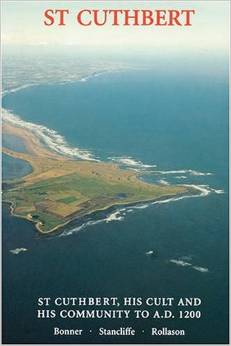
The following tribute to my late father was authored by William Peak in 2014 and he has been kind enough to permit me to post it on this blog. You can find the original post here.
I
believe it was sometime in 1988 that I sent Gerald Bonner the telegram.
I was thinking about writing a novel, and I’d done just enough research
to know he was the expert when it came to the time and place in which I
wanted to set my story: Northumbria, the 7th century. So I sent him a
telegram (“Yes, Virginia, there was a time before e-mail.”) and asked if
I might meet with him when I came to England to research my book. Then I
sat back and waited for a reply.
None came.
To
say I was disappointed would be an understatement. I have great respect
for professional historians, and I am well aware of the fact I am not
one. So when my first attempt to contact one of the big names in the
field met with silence, I felt as if I’d been found out. See, I thought,
this is what you get for believing you could write a work of historical
fiction. The real pros, like Bonner, won’t have anything to do with
you.
Still,
the tickets for England had already been purchased. So I made my trip,
visited all the sites and archives I’d hoped to visit, and then, despite
misgivings, drove up to Durham University where Bonner then served as a
professor of history in the Department of Theology and Religion. On my
second day there, I screwed up my courage, put on my best bib and
tucker, and marched into the great man’s office unannounced.
And he met me with open arms.
It
turned out he had received my telegram and had wanted to reply to it
but couldn’t. The form I’d filled out at the telegraph office had
required me to list both my home address and telephone number, and,
foolishly, I had assumed that this information would be transmitted
along with my telegram to its recipient. It hadn’t been, which explained
Bonner’s silence.
But
the good professor wasn’t silent now. Despite the fact I didn’t have an
appointment, despite the fact he was a busy man with, I assume, any
number of classes to teach and projects to pursue, he dropped everything
and spent the better part of that afternoon talking with me and
advising me on my book. You cannot imagine how important it was to me to
have a man of Bonner’s stature take me and my ideas seriously. It gave
me courage, it strengthened my resolve, I found myself beginning to
believe in this novel I wanted to write. It could be done, I thought, it
could be written. I could write it.

The
book that grew out of that conversation in a Durham University office in
1988, The Oblate’s Confession, will be officially launched this Monday,
Dec. 1. Unfortunately, Gerald Bonner passed away last year. I hope he
would have been liked my book, for his encouragement and inspiration
helped create it. And he was such a fine man. At one point in our
conversation, I remember, I asked him if he ever read historical fiction
himself. “I like to take my history neat,” he replied, but then,
doubtless noticing the look of disappointment that must have passed over
my face, he added, “though I did rather enjoy that novel by the
American writer, Frederick Buechner, what was its name? Godric, that’s
it, Godric!” How kind a verbal postscript that was, how kind and how
characteristically generous. I owe Gerald Bonner a great deal. May he
rest in peace.



 Posts
Posts


